
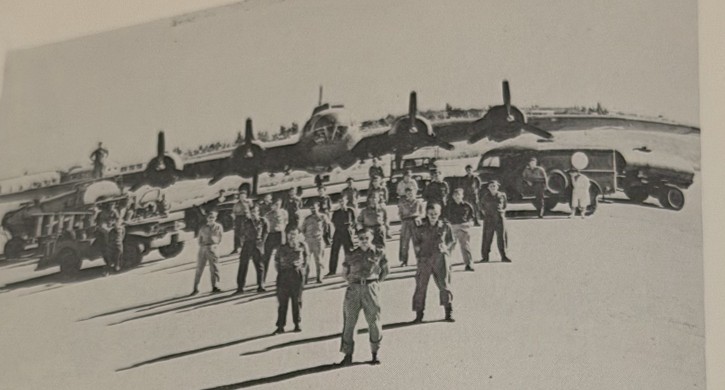
On the evening of October 28, 1948, three B-17 Flying Fortresses lined up on the runway at Ramat David and pushed their throttles forward. The sun was dropping into the Mediterranean behind them. Ahead lay the hills of the upper Galilee, where a guerrilla commander named Fawzi el-Kaukji had just handed Israel the excuse it had been waiting for. In the lead bomber sat Al Raisin, a veteran of twenty-five missions over Germany with the U.S. Eighth Air Force. Beside him in the other two Fortresses were Bill Katz and Sam Feldman, both Americans, both former bomber pilots who had crossed an ocean to fly again. Their target was Kaukji’s headquarters in the village of Tarshicha. Their bomb run was the opening shot of Operation Hiram.
A fox driven into a second den
Kaukji’s Arab Liberation Army was unfinished business. Back in July, during Operation Dekel, Ben Dunkelman’s Seventh Brigade had chased him out of Nazareth and the coastal and central Galilee; a column of three armored cars and a half-track had shot its way through his roadblock outside the city and broken the siege of the north’s holiest town. Dekel hadn’t finished him, though. Kaukji simply pulled back into the hill country around Sasa, Tarshiha, and Jish and kept fighting from there, pressing the Jewish settlements at Eilon and Manara and keeping the Metulla-Tiberias road under threat all through August and September while Dunkelman’s brigade sat in Safed, waiting.
Through the autumn, Israel’s attention was fixed on the south. Operation Yoav, fought October 15-22, was the main event: a bid to keep the Negev out of Egyptian hands before international pressure, embodied in the Bernadotte Plan and backed by both Britain and the United States, could impose a peace that handed the desert to the Arabs. Israeli commanders had learned the hard lesson of 1948 diplomacy: whatever ground an army actually held when a cease-fire came into effect froze the map. It was the ground it was likely to keep, UN resolutions notwithstanding. That calculus applied just as sharply to the Galilee, and more urgently, because the Galilee sat on the Lebanese and Syrian borders. Every week Kaukji survived was another week the Syrians or Lebanese might reinforce him and turn a mopping-up action into a second front.
What Israel needed was a pretext. All through the war, the pattern had held: wait for the other side to break a truce, then answer in force. Kaukji supplied it on October 22, raiding south out of Lebanese-held territory while Israeli troops were still finishing off the Egyptians in the south. Israel’s UN representative filed the obligatory protest. The UN, true to form, did nothing. With Yoav wrapping up and troops coming free, Ben-Gurion gave the order for the operation that had reportedly been sitting ready since September. It carried one more name drawn from the Bible: Hiram, the ancient king of Tyre who had helped Solomon build his Temple.
Four brigades, two squadrons, one very different Israeli Army
Hiram’s ground plan threw four brigades at a single road junction. Dunkelman’s Seventh Brigade carried the main assault, driving from Safed through Jish to Sasa and on to the Lebanese frontier. The Oded Brigade mounted a diversionary attack from Nahariya through Tarshiha. The Golani Brigade, which counted American Simon Spiegelman of New York among its soldiers, pushed south to keep the Iraqis from coming to Kaukji’s aid, and the Carmeli Brigade leaned on the Syrians to secure the Seventh’s rear near Mishmar Hayarden. Overhead flew two squadrons: 69 “Hammer” Squadron’s three B-17s, which opened the operation over Tarshicha and flew on to thirty-four total missions, and 101 Squadron’s Spitfires, flying escort out of Herzliya on every one of those runs.
These units differed sharply in makeup. The Oded, Golani, and Carmeli Brigades were, by and large, native Israeli formations doing supporting and diversionary work. The Seventh Brigade was something else: along with the tank companies of the Eighth Brigade, it stood out among the ground forces for carrying a heavy volunteer component. Its 72nd Battalion carried that distinction outright, known as the English-speaking Battalion and built largely out of Americans and Canadians, the same battalion whose morale had cracked badly enough the week before Hiram that eleven of its soldiers staged a sit-down strike and were marched off to prison for it. In the air the proportions ran further still. The Israeli Air Force was, for all intents and purposes, an all-volunteer force, so both 69 and 101 Squadron flew Hiram almost entirely with foreign volunteers at the controls, Americans and Canadians chief among them.
Three Americans over Tarshicha
Raisin, Katz, and Feldman swept in from the west and put fourteen 100-kilogram bombs apiece onto Kaukji’s headquarters. The hills were still shaking when the four brigades poured into the guerrilla-held territory behind them. Over the next two nights the Hammers flew thirteen more sorties, escorted on every run by Spitfires out of Herzliya so that no Egyptian, Iraqi, or Transjordanian fighter dared come up to meet them. That fighter cover belonged to Red Squadron, 101 Squadron: the same outfit that, just a week earlier over the Negev, had put American Rudy Augarten and Canadian Jack Doyle on the wing of an Egyptian Spitfire, with fellow Canadians John McElroy and Denny Wilson and American Slick Goodlin flying alongside them. By the time the last cease-fire took effect on October 31, the three Fortresses had flown thirty-four missions and dropped twenty-seven tons of bombs on Arab Liberation Army targets. Operation Hiram had lasted sixty hours.
Dunkelman’s night at Jish
While Albert Raisin, William Katz, and Sam Feldman were still climbing out over the coast, engineers and sappers from the Seventh Brigade were out in the dark on the road west of Safed, clearing roadblocks and bridging wadis. None of them had slept in preparation for the assault. The brigade’s commander was a six-foot-three former major of the Queen’s Own Rifles of Canada named Ben Dunkelman, a Toronto native who had won the Distinguished Service Order fighting across Europe and who had come to Israel to serve, at first, as an ordinary soldier on a mortar crew before his record caught up with him. By 3:30 a.m. the obstacles were cleared, and the Seventh’s armored column raced up the hill into Jish, Kaukji’s own headquarters village, with guns blazing. By daybreak the town was taken.
It was only the opening move. The real objective lay at Sasa, where the four main roads of the northern Galilee crossed, and all four brigades were converging on it. When the Oded’s column stalled in a minefield outside Tarshiha, it was the Seventh that kept moving, clearing Mount Atzmon’s flank and forcing its way into Sasa by midday on October 29. Dunkelman held a staff conference that night with officers who had not slept since the morning before, everyone on their feet just to stay awake, and then sent the column north again. Kaukji was given no time to regroup. By nightfall on October 30 his Arab Liberation Army and the Lebanese units backing it had been routed out of the upper Galilee for good, and Israeli troops stood on the Lebanese frontier.
The cost
Not every North American who marched into the Galilee that week marched out. Serving in Company B of the 72nd Battalion was nineteen-year-old Sidney Leizerowitz of Toronto, who had enlisted barely two months before. He was killed at Tamra in the fighting of Operation Hiram and is buried in the military cemetery at Nahariya. He had joined the same battalion whose Company B had staged that sit-down strike a week earlier. Whatever grievances they carried into October, they fought the battle anyway.
The volunteer airmen had already lost men over the Galilee before Hiram’s first bomb fell. On the night of October 24-25, a Dakota flown by Canadian Wilfred Canter, a man who had survived being shot down twice over Europe in the war (once evading capture with the French underground, once enduring a German POW camp), caught fire on approach to Ekron and went down, killing Canter and his fellow Canadians William Fisher and Fred Stevenson. It was a reminder, days before Hiram opened, of what the volunteers’ war had already been costing, and of what more of it would cost before the Galilee was secured.
What sixty hours bought
By October 31, Fawzi el-Kaukji’s Arab Liberation Army was finished as a fighting force: nearly two thousand of his surviving fighters scattered along smugglers’ trails into Lebanon, never to return as a serious threat. The Lebanese Army showed no appetite to pick up where he had left off. Israel now held the entire upper Galilee to the Lebanese border, including territory the UN’s 1947 partition plan had marked for a future Arab state. When the UN Security Council demanded on November 4 that Israel withdraw to its pre-October 14 lines, surrendering everything won in Yoav and Hiram alike, Ben-Gurion refused outright. The Galilee the Americans and Canadians of the Seventh Brigade and the 69 Squadron had just fought sixty hours to take was not going back.
That is the shape this volunteers’ war kept taking. Ordinary men from Toronto and Baltimore and Philadelphia and Jacksonville climbed into war-surplus bombers and fighters for a country where none of them held citizenship. For sixty hours in October 1948, Israel needed exactly those men, and they answered.
Source: Robert Gandt, Angels in the Sky: How a Band of Volunteer Airmen Saved the New State of Israel; David J. Bercuson, The Secret Army; A. Joseph Heckelman, American Volunteers and Israel’s War of Independence; and the volunteer service records of the North American Volunteers In Israel’s War of Independence project at israelvets.com. Photograph courtesy of the Israel Defence Forces Archives, reproduced from The Secret Army.